Simcenter Simsolid
Multi-physics simulation for full CAD assemblies, high accuracy results, and instant design comparisons

SimcenterTM SimsolidTM is a Siemens product
SimcenterTM SimsolidTM is a Siemens product
Simcenter Simsolid is a revolutionary simulation and structural analysis solution built for designers, engineers, and analysts who need fast, reliable insights. By removing the need for geometry cleanup and meshing, Simcenter Simsolid lets you validate structural performance in just minutes, using your full, detailed CAD models exactly as they are.
Unlike traditional FEA software, Simcenter Simsolid works directly on complete and complex CAD assemblies with no simplification required. This drastically accelerates simulation cycles, enabling rapid design iterations and earlier decision making. Powerful, precise, and incredibly fast, Simcenter Simsolid helps engineering teams explore more design options, improve product performance, and bring higher quality products to market faster.

No geometry simplification. No meshing. Simcenter Simsolid eliminates the most time consuming and error prone steps of conventional FEA. Your CAD file becomes your simulation model — instantly.
Built for speed and scalability, Simcenter Simsolid handles big assemblies and intricate parts with ease, even models with imperfect contacts, gaps, and overlapping surfaces.
Run structural analyses in seconds or minutes on a standard PC. Quickly compare multiple design iterations and accelerate simulation driven development across industries.
Simcenter Simsolid supports linear and nonlinear statics, thermal analysis, modal analysis, fatigue, stress linearization, and dynamic simulations (time, frequency, global local, buckling, composites, squeak & rattle, thermal stress, random response) for fast, end to end structural evaluation.
Includes frictional, bonded, sliding, and separating contacts, plus bolts, virtual connectors, welds, rivets, adhesives, joints, and bushings. Materials supported include isotropic, orthotropic, elastic plastic, rigid, gas, and fluid bodies.
Simulate real world conditions: fixed and sliding supports, hinges, forces, pressures, gravity, thermal loads, inertia, hydrostatic loads, bolt tightening, volumetric changes, remote masses, and remote loads.
Imports all major CAD and PLM formats (CATIA, NX, Creo, Inventor, Fusion 360, SOLIDWORKS, JT, STEP, Parasolid, ACIS, STL, and more) without conversion. Features direct integration with Onshape and Teamcenter.
Explore results through contour maps, animations, XY plots, probes, and detailed metrics for stress, strain, displacement, safety factors, modal shapes, and frequencies. Supports section cuts, datum planes, and load case combinations.
Automatically identifies part types during CAD import, reducing manual cleanup and speeding up setup.

Send your technical questions to our experts!
Connect you with an EnginSoft expert who can provide a reliable answer to your technical question or recommend a
proven solution.

CASE STUDY
This technical article describes a project undertaken by OPEM to optimize and validate the laws of motion governing the moving operations of a machine that produces coffee capsules, namely the cut and weld unit, the film feeder, the conveyor and the support structure.
consumer-goods multibody recurdyn food-beverage mechanics

CASE STUDY
The adoption of SBES has significantly increased in the last two decades, driven by advancements in computing technology and the rise of Industry 4.0, which promotes nine key enabling technologies, including engineering simulation and big data analytics. SBES is crucial for the integration and automation of production systems, improving flexibility, speed, and quality.
automotive construction energy cfd metal-process-simulation
CASE STUDY
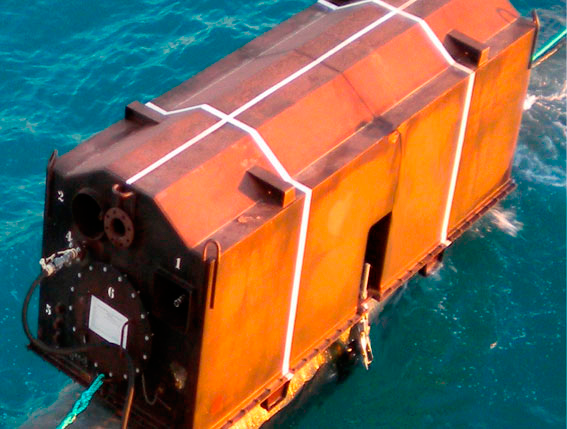
A developer of innovative equipment designed a system to simplify the towing and laying down of marine pipelines in shallow water fields.
energy modefrontier optimization oil-gas recurdyn
CASE STUDY
In a recent interview, Enrico Boesso (EnginSoft) and Daniel Campbell (Capvidia) discussed how Model-Based Definition (MBD) is transforming manufacturing by replacing traditional 2D drawings with data-rich 3D models as the "single source of truth".
comparevidia mbdvidia tolerances digital-manufacturing mechanics

CASE STUDY
This paper presents the preliminary simulation study of a typical centrifuge currently produced by Gamma Meccanica. The objective of this study is to evaluate the behaviour of the centrifuge using moving particle simulation and discrete element method (MPS-DEM) simulation techniques with Particleworks 7.2.1 to gain a better understanding of phenomena that are impossible to monitor experimentally.
mechanics particleworks