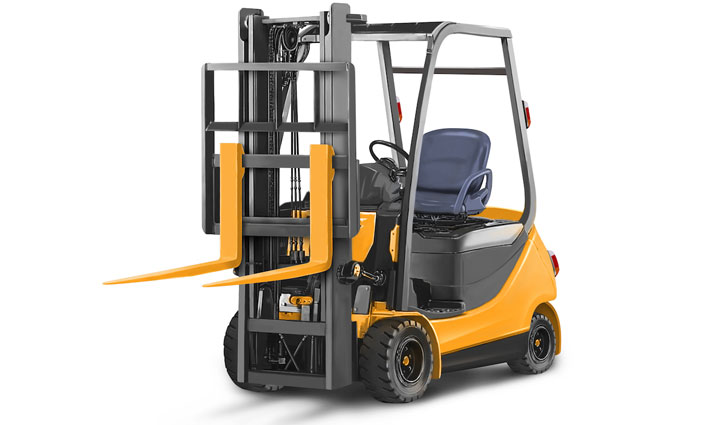
Forklift Dynamics
A client wanted to evaluate the dynamic performance of a new-concept forklift, so a fully-functional multibody model of the forklift was built by assembling the client’s CAD geometries.
The forklift’s wheels were represented in detail to implement a sophisticated model of the tire features, which were calibrated from experimental data.
In addition, the interaction between the fork and a real item of freight was able to be simulated as a result of RecurDyn’s efficient contact features.
This type of highly-detailed model can be used to simulate many different scenarios: for example, a crucial handling test can be performed by simulating the loaded forklift crashing into a standard obstacle.
Various load cases and driving maneuvers can be set up in order to assess the forklift’s static and dynamic stability; in addition, the loads that each part of the forklift can be measured and used as input for structural and fatigue-life verification.